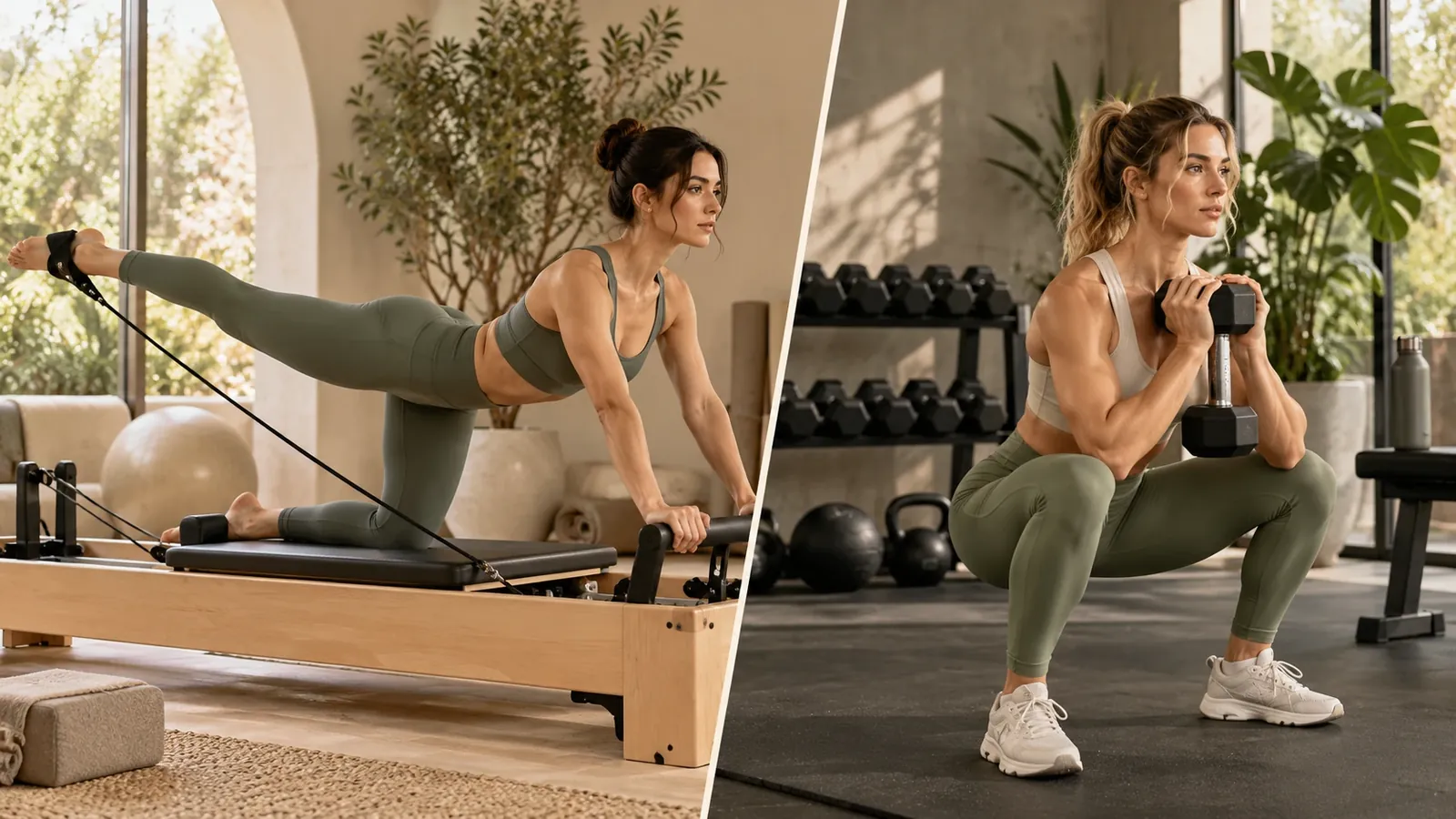
Pilates and strength training can both challenge muscles, but they are not identical training systems. Pilates often emphasises controlled movement, trunk stability, coordination, flexibility, and resistance through body weight or specialised apparatus, while strength training more directly manipulates external resistance to increase force-producing capacity.
That distinction matters when deciding what someone wants from a programme. Pilates may fit goals around movement quality and core control, while progressive resistance training has a stronger evidence base for building maximal strength and preserving or increasing bone mineral density.
The Pilates vs strength training choice does not have to be permanent or exclusive. Many people can combine both methods, especially when flexibility, movement quality, strength, and long-term physical function are all priorities.
Key Takeaways
- The Health & Fitness Association reported that Pilates participation among US fitness-facility members grew 28.1% between 2021 and 2025.
- US physical activity guidance recommends muscle-strengthening activity on at least two days per week for adults.
- A 2022 systematic review found low- to very-low-certainty evidence of no clear strength advantage for Pilates compared with other exercise modalities across several measured outcomes.
- A 2026 systematic review of Pilates in adult women found clearer evidence for flexibility than for lean mass, handgrip strength, or explosive power.
- Resistance training has a larger evidence base for improving maximal strength and bone mineral density, particularly in postmenopausal women.
- Pilates can still contribute to muscular endurance, control, balance, and selected strength outcomes depending on the programme.
- Someone can use Pilates and strength training together rather than treating them as competing choices.
Pilates vs Strength Training at a Glance
| Difference | Pilates | Strength training |
|---|---|---|
| Main training emphasis | Control, trunk stability, coordination and mobility | Progressive force production and overload |
| Resistance | Body weight, springs, bands, apparatus | Free weights, machines, bands, body weight |
| Progression | Exercise complexity, range, spring tension, control | Load, reps, sets, tempo and exercise difficulty |
| Maximal strength | Can improve strength | Stronger evidence for targeted increases |
| Flexibility | Often integrated into sessions | Depends on exercise selection and range |
| Bone-loading potential | Variable | Stronger evidence when sufficiently loaded |
| Equipment | Mat or reformer/apparatus | Dumbbells, barbells, machines or body weight |
| Best used for | Movement quality, core control, flexibility, mixed fitness | Strength, hypertrophy, bone loading and measurable progression |
1. The Resistance Is Applied Differently
Pilates can use body weight, springs, bands, or apparatus such as the reformer. Resistance is often integrated with controlled movement, breathing, alignment, and repeated transitions rather than treated as a separate lifting task.
Strength training can also use body weight or bands, but it commonly uses dumbbells, barbells, machines, kettlebells, or other external resistance. The central principle is that training demand can be progressively increased as the body adapts.
Why This Difference Matters
A reformer spring can challenge muscles without functioning like a barbell squat or leg press. Both create resistance, but the ability to quantify and increase load is usually more straightforward in conventional strength training.
That makes traditional resistance training easier to programme specifically for maximal strength or hypertrophy. Pilates progression can be more multidimensional, involving control, lever length, movement complexity, spring tension, tempo, and balance.
2. Strength Training Has a Clearer Progressive Overload Model
Progressive overload means gradually increasing training demand over time. In resistance training, this can involve more weight, more repetitions, more sets, greater range of motion, or more difficult variations.
Pilates can also progress, but progression is not always measured in kilograms or repetitions. An instructor might increase spring resistance, reduce assistance, change body position, or introduce a more challenging movement sequence.
Which Is Easier to Measure?
Strength training is generally easier to quantify for performance goals. A person can record a squat, deadlift, press, or machine load and compare performance over weeks or months.
Pilates can still be tracked, but improvement may appear as better control, range, stability, or the ability to perform more advanced exercises. Those outcomes can be meaningful even when they are harder to express in one number.
3. Muscle Strength Outcomes Are Not Identical
A 2022 systematic review examined Pilates against other exercise modalities for muscular strength. Across 11 included studies, the researchers found very-low- to low-certainty evidence showing no clear difference between Pilates and other exercise for dynamic, isometric, or endurance-related strength outcomes.
That finding does not mean Pilates and heavy resistance training are interchangeable. The studies included different populations, programmes, comparators, and strength tests, which limits broad conclusions.
Newer Evidence in Women
A 2026 systematic review and meta-analysis examined 12 studies involving about 540 adult women. Pilates showed significant pooled improvement in flexibility, while no significant pooled effect was found for lean body mass, handgrip strength, or vertical jump.
Narrative findings suggested improvements in some strength and endurance measures, but the review emphasised methodological heterogeneity and low certainty for many outcomes. The strongest conclusion was not that Pilates fails to challenge muscle, but that results differ substantially by programme and measurement.
What Conventional Strength Training Offers
Resistance training is specifically designed to improve force production through progressive loading. That makes it the more direct choice when maximal strength or muscle hypertrophy is the primary goal.
Pilates may still contribute to muscular endurance, core strength, and functional control, especially for people who enjoy the method enough to train consistently. Evidence in older adults is weaker still: a 2024 review concluded that Pilates could not yet be recommended specifically to improve strength in that group.
4. Bone Health Is a Major Difference
Adults are advised to perform muscle-strengthening activity on at least two days per week. Resistance exercise can also provide mechanical loading relevant to maintaining skeletal health.
A 2025 meta-analysis of 17 randomised trials involving 690 postmenopausal women found that resistance training significantly improved bone mineral density at the lumbar spine, femoral neck, and total hip. The studies varied substantially, so exact effect sizes should be interpreted cautiously.
More Recent Evidence
A 2026 systematic review of high-intensity, impact, and strength training found small but statistically significant improvements in bone mineral density at the femoral neck and lumbar spine in postmenopausal women.
Pilates can involve weight bearing and muscular resistance, but it does not always provide the same external loading stimulus as progressive weight training. People specifically concerned about bone density should discuss appropriate loading with a qualified healthcare or exercise professional, particularly when osteoporosis or fracture risk is present.
5. Pilates Places More Emphasis on Flexibility and Movement Control
Pilates sessions often integrate movement through controlled ranges with trunk stabilisation and attention to breathing. Flexibility and movement quality are therefore built into many exercises rather than added as separate components.
The 2026 meta-analysis in adult women found a statistically significant pooled improvement in sit-and-reach flexibility. However, study heterogeneity was high, meaning the exact size of the benefit varied across programmes.
Strength Training Can Also Improve Range of Motion
Resistance training does not automatically reduce flexibility. Exercises performed through full ranges can maintain or improve mobility while also building strength.
The practical difference is that flexibility and control are usually explicit priorities within Pilates. In strength programmes, they depend more on exercise selection, technique, and programme design.
6. Equipment and Environment Can Change the Cost
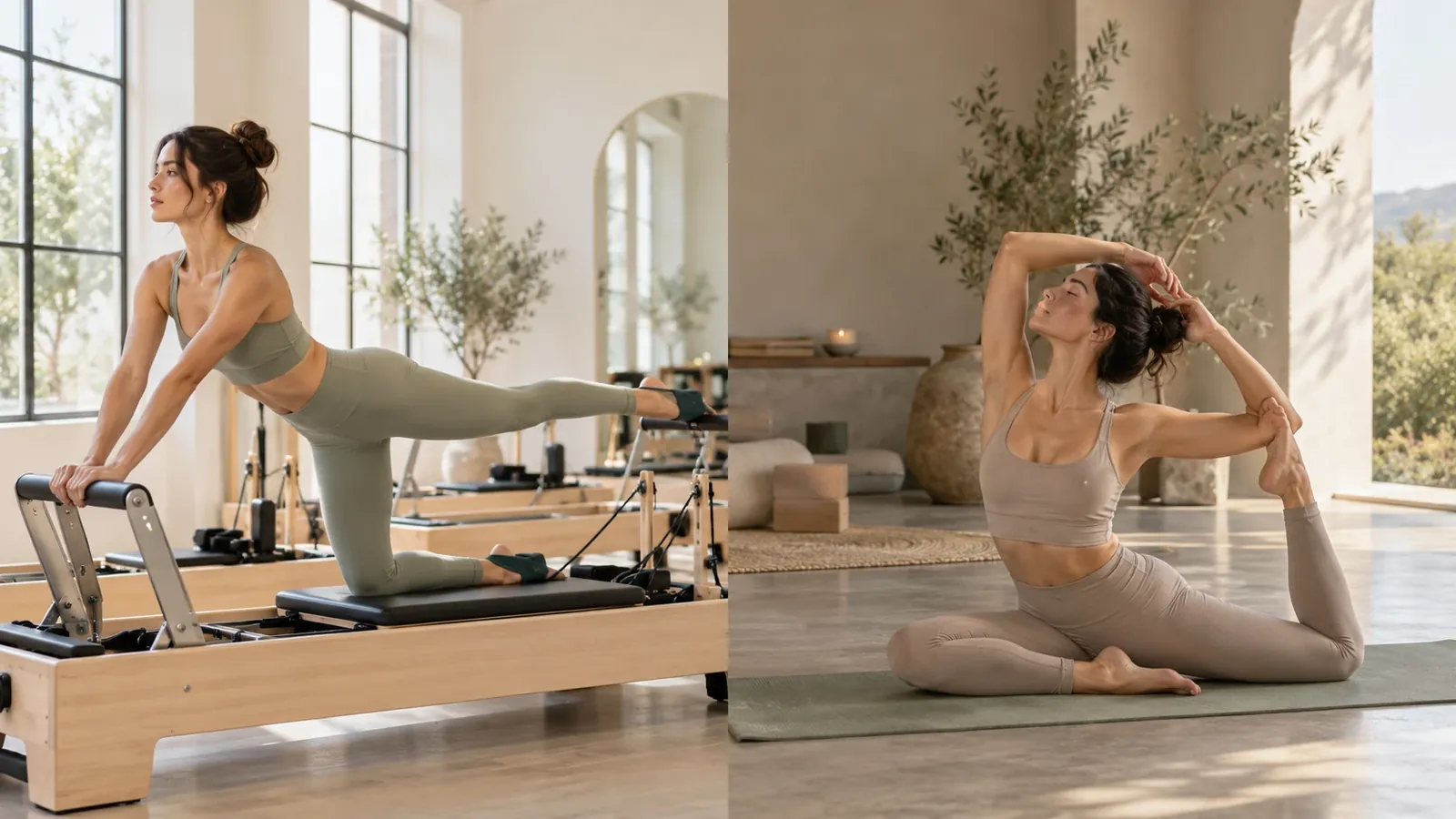
Mat Pilates can require very little equipment. Reformer Pilates, by contrast, depends on specialised apparatus and is commonly delivered through instructor-led studios.
Strength training can range from bodyweight programmes at home to full commercial gyms. Dumbbells and resistance bands can support lower-cost home training, while heavier lifting may require a gym or more substantial equipment.
Studio Pilates Can Be More Expensive
Reformer classes often operate with fewer participants because each person needs a machine. That can increase per-class prices compared with large group classes or basic gym access. You can estimate your monthly and annual Pilates class cost from your studio's published prices.
Strength training can be comparatively inexpensive through a standard gym membership, but personal coaching can increase the cost substantially.
7. Pilates Participation Is Growing Rapidly
The Health & Fitness Association reported that US fitness-facility membership reached 81 million in 2025, with more than 100 million total facility users when non-members were included.
Pilates participation grew quickly. HFA reported a 28.1% increase in Pilates participation among fitness-facility members from 2021 to 2025.
Strength Training Remains Central to Facility Use
HFA also reports continued movement toward strength-based and functional training. In 2025, more than half of dumbbell users used them weekly, indicating high habitual engagement.
This suggests that Pilates growth is happening alongside, rather than replacing, strength training. Consumers may increasingly use multiple forms of exercise across studios, gyms, and home programmes.
8. The Best Choice Depends on the Goal
Someone seeking maximal strength, muscle growth, or a structured bone-loading programme will generally find conventional strength training easier to progress and measure.
Someone who values guided movement, coordination, trunk control, and flexibility may prefer Pilates. Consistency is still important because neither method produces meaningful adaptation when participation is too infrequent.
Combining Pilates and Strength Training
A combined routine can use resistance training for progressive loading and Pilates for movement quality, trunk control, and variety. The exact schedule depends on training history, recovery capacity, and goals.
For example, someone might complete two or three resistance sessions and one Pilates class each week. That is only an example, not a universal prescription, and individual needs can differ substantially.
Market Data: Why Both Formats Are Growing
The US fitness facility market reached record participation in 2025. HFA reported 81 million members, 26.1% membership penetration, and an estimated 7 billion facility visits.
Pilates participation increased 28.1% between 2021 and 2025, while strength and functional training continued gaining importance across gym usage. These trends indicate that consumers are not choosing only one format.
Hybrid training can also appear within fitness apps for women and boutique studios.
How to Choose Between Pilates and Strength Training
Consider the following before choosing a primary training method:
- Is the goal maximal strength, flexibility, movement quality, or general fitness?
- Is bone loading an important priority?
- Is access to a reformer studio realistic?
- Does the person prefer independent lifting or instructor-led sessions?
- Is measurable load progression motivating?
- Are there injuries or medical conditions requiring professional guidance?
- Which method is more likely to be continued consistently?
- Could a combined programme address more than one goal?
The right choice is often the one that matches both the physical objective and the person's preferred way of training.
FAQs
Is Pilates the Same as Strength Training?
No. Pilates creates muscular resistance and can improve selected strength and endurance outcomes, but it generally emphasises control, trunk stability, coordination, and flexibility. Conventional strength training more directly uses progressive overload to increase force production and muscle adaptation.
Is Pilates Enough for Building Muscle?
Pilates can challenge muscle and may improve selected muscular outcomes, particularly in beginners. However, progressive resistance training provides a more direct and measurable approach to hypertrophy because external load can be systematically increased over time.
Is Pilates Better Than Strength Training for Flexibility?
Pilates commonly integrates flexibility and controlled range of motion into sessions, and recent research supports improvements in flexibility. Strength training performed through full ranges can also improve mobility, so the difference depends on programme design.
Which Is Better for Bone Density?
Progressive resistance training has stronger evidence for increasing or preserving bone mineral density, particularly in postmenopausal women. Pilates can contribute to physical function but may not provide the same magnitude of external skeletal loading.
Can Pilates and Strength Training Be Done Together?
Yes. Many people use strength training for progressive loading and Pilates for movement quality, flexibility, trunk control, and variety. The appropriate weekly balance depends on goals, experience, schedule, and recovery.
Is Pilates Safer Than Lifting Weights?
Neither method is universally safer. Risk depends on exercise selection, technique, training load, instructor quality, health status, and progression. People with injuries, osteoporosis, or other medical concerns may need individual guidance before beginning either programme.
Sources
- CDC Adult Physical Activity Guidelines
- Health & Fitness Association, 2026 US Consumer Report
- HFA Fitness Participation Analysis
- Pinto J.R. et al. 2022 systematic review of Pilates and muscle strength
- Bajčetić C. et al. 2026 Pilates meta-analysis in adult women
- Zhao F. et al. 2025 resistance training and bone mineral density meta-analysis
- Jones E. et al. 2026 high-intensity, impact and strength training BMD review
- Oliveira L.S. et al. 2024 Pilates strength review in older adults
Research note: Pilates and resistance-training studies vary in programme design, duration, population, and comparator exercise. Findings should not be interpreted as a personalised exercise prescription.