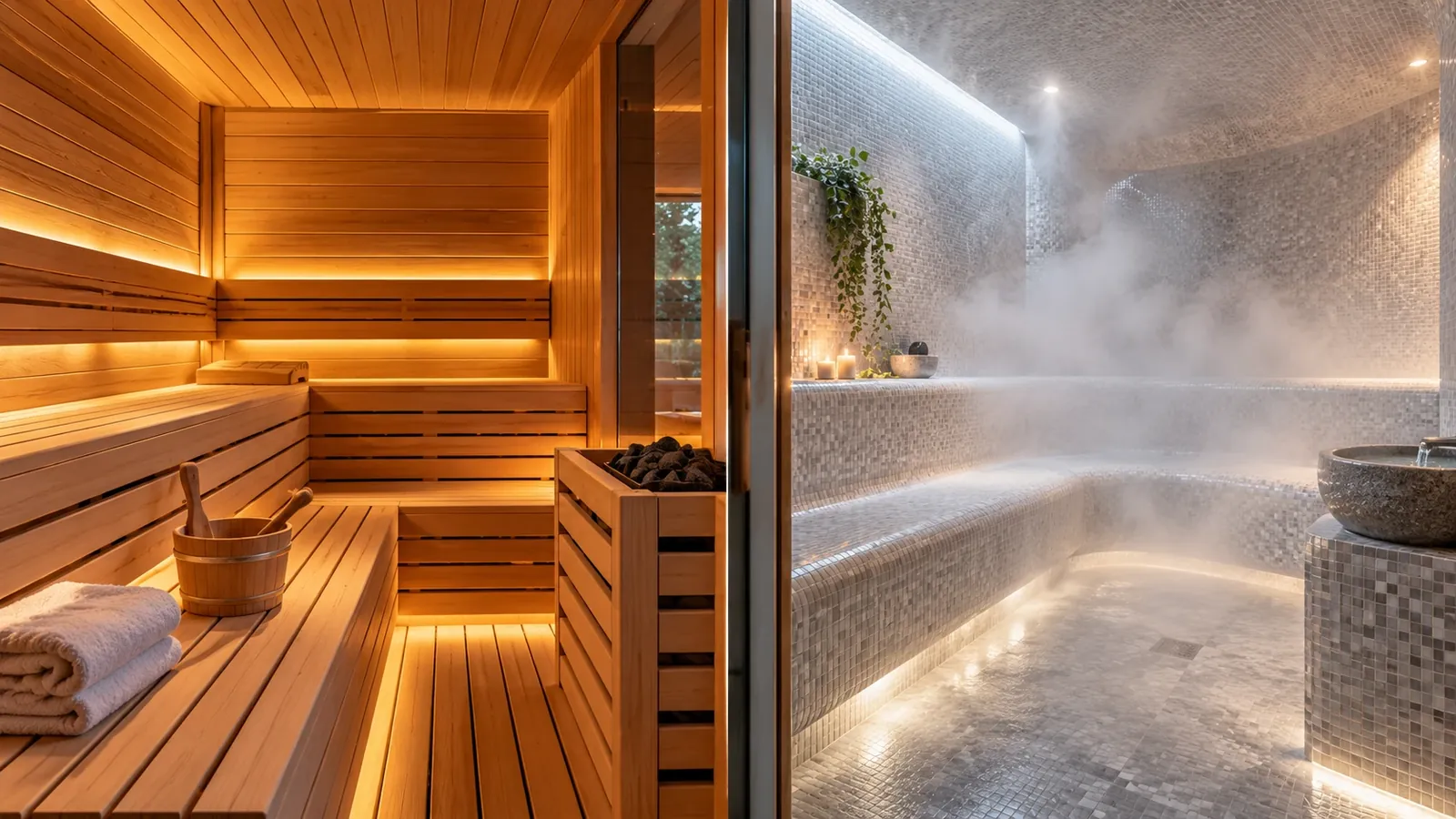
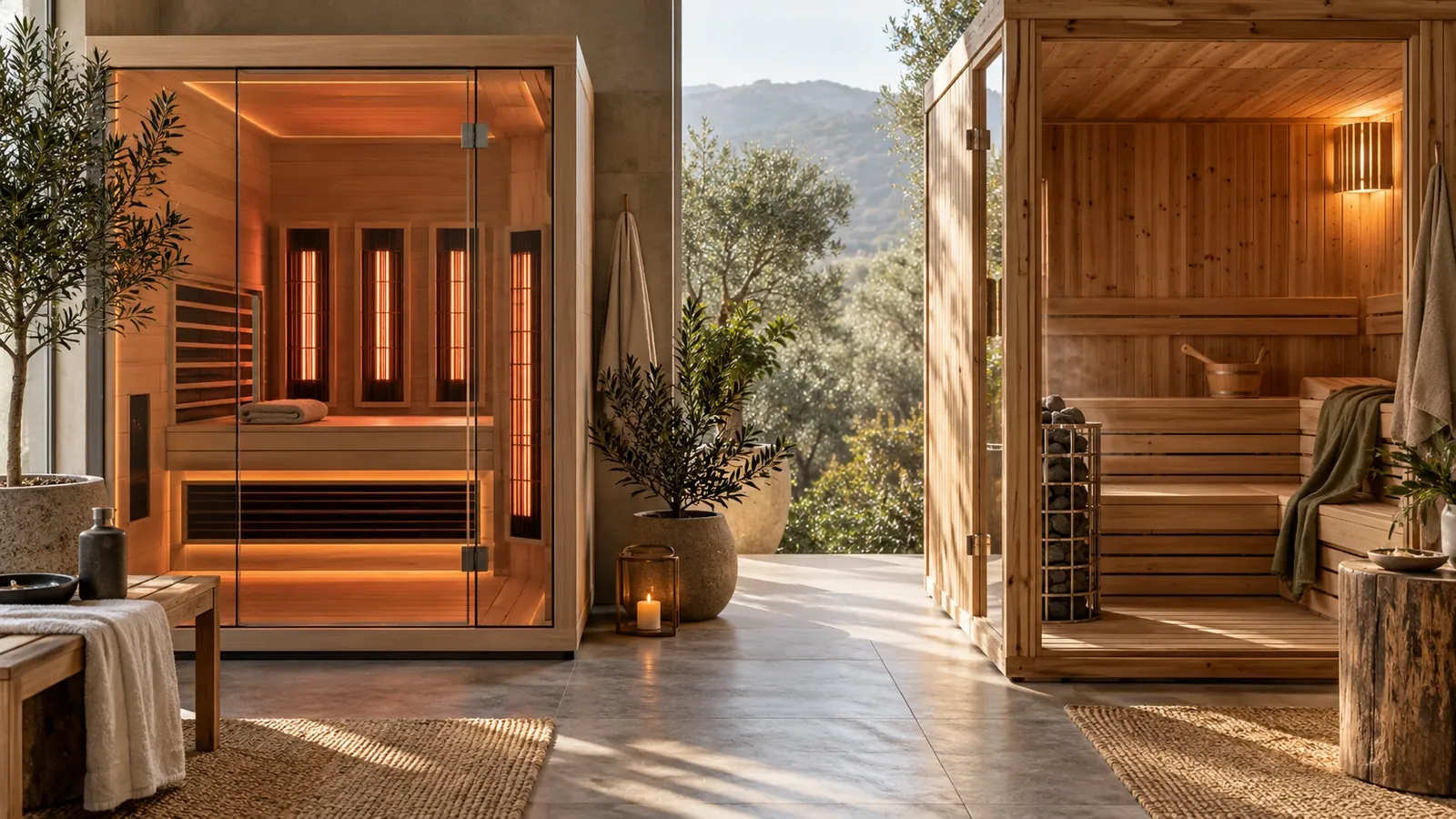
An infrared sauna and a traditional sauna both expose the body to heat, but they create that heat differently. That difference affects room temperature, installation, operating conditions, and the evidence behind claims about health benefits.
The infrared sauna vs traditional sauna decision is therefore about more than which cabin feels hotter. Buyers also need to compare electrical requirements, cleaning, purchase costs, and whether research on one method can reasonably be applied to the other.
Key Takeaways
- Traditional electric saunas heat the room with a stove or heater, often warming stones that can be used to create short bursts of steam. Infrared heaters emit radiant energy that can warm the body in a lower-temperature cabin.
- Mayo Clinic describes infrared saunas as generally operating at lower air temperatures than traditional saunas. This difference does not establish that infrared treatments deliver superior health outcomes.
- Long-term observational studies linking sauna use with lower cardiovascular mortality largely concern Finnish-style sauna bathing, not consumer infrared blankets or every type of infrared cabin.
- Installation can vary substantially: a specific Almost Heaven four-person electric barrel sauna requires a 240-volt, 30-amp hardwired heater circuit, while electrical needs differ by infrared model.
- Manufacturer examples show wide price variation. HigherDOSE listed a $699 infrared blanket and a full-spectrum cabin from $7,999 (two-person; $8,999 for three-person), while Almost Heaven listed a four-person Pinnacle barrel sauna at $6,060 during the research check.
- Neither type should be presented as an established detoxification, disease-treatment, or permanent fat-loss intervention. People with relevant health conditions should discuss heat exposure with an appropriate clinician.
Infrared Sauna vs Traditional Sauna at a Glance
The terms describe two broad heating systems rather than two uniform products. Individual models can differ in heater output, insulation, construction, controls, occupancy, and electrical configuration.
| Comparison | Infrared sauna | Traditional sauna |
|---|---|---|
| Main heat source | Infrared radiant heaters | Electric or wood-burning stove heating cabin air and often stones |
| Air temperature | Usually lower than traditional sauna | Usually higher room temperature |
| Humidity | Typically dry unless a separate system adds moisture | Usually dry, but water on hot stones creates temporary humidity |
| Primary experience | Radiant warmth at a lower air temperature | Hot air, optional steam bursts, and heated surfaces |
| Common consumer formats | Blankets, compact cabins, full-spectrum cabins | Indoor rooms, barrel saunas, outdoor cabins |
| Installation | Model-dependent; blanket or cabin requirements differ | Heater and room construction, ventilation, and electrical or chimney requirements |
| Clinical evidence | Smaller and more varied intervention studies | More long-term observational Finnish sauna evidence |
| Ownership costs | Device price, energy, cleaning, repairs | Cabin/heater price, installation, energy or fuel, maintenance |
The table describes general categories, not a claim that all infrared models use an ordinary wall outlet or that every traditional sauna needs the same circuit. Confirm product-specific instructions and local electrical requirements before any purchase.
1. Heating Method: Radiant Energy Versus Hot Air
The main technical difference is how heat reaches the user. Traditional electric saunas primarily heat the air and surrounding surfaces, while infrared devices rely on radiant heaters within an enclosed space or wearable enclosure.
How Infrared Heating Works
Infrared sauna heaters emit infrared radiation that can be absorbed by surfaces and the body. The surrounding air also warms during use, but the system does not need to produce the same high air temperatures as many conventional saunas.
Mayo Clinic describes infrared sauna operation as direct heating at a lower surrounding air temperature. This is a useful explanation of the mechanism, not confirmation of greater clinical effectiveness or a special detoxifying process.
How Traditional Sauna Heating Works
A traditional electric sauna uses a high-output heater to warm cabin air and often a bed of stones. Users may add water to suitably designed hot stones, creating short increases in humidity and an immediate change in the heat sensation.
Wood-fired versions use combustion rather than an electric heating element, introducing ventilation, flue, and fire-safety requirements. Traditional saunas are not identical to steam rooms, which are designed around persistently high humidity.
2. Temperature and Perceived Heat
Infrared rooms are commonly marketed as comfortable at lower temperatures, whereas traditional saunas are associated with hotter air. Comfort still depends on session length, personal heat tolerance, humidity, ventilation, and equipment design.
Air Temperature Is Not the Whole Experience
A lower room temperature does not mean heat stress disappears. People can still become overheated or dehydrated in an infrared sauna because the body is absorbing heat and sweating to regulate temperature.
Traditional sauna users may experience stronger convective heat and more intense sensations when water is added to stones. Comparisons should therefore describe both air temperature and how the particular system transfers heat.
Avoid Comparing Settings That Measure Different Things
A sauna controller may display room temperature, while an infrared blanket may specify a heating element setting. Those values cannot always be compared directly as though both represent the same air or skin temperature.
Product listings often describe maximum temperature without specifying the test method. Readers should check the manual rather than assume higher numbers prove better performance.
3. Humidity and Ventilation
Both traditional and infrared saunas are often dry, but their moisture exposure can differ in practice. The water-on-stones feature associated with Finnish-style sauna bathing is an important experiential distinction.
Traditional Saunas Can Produce Short Steam Bursts
Adding small amounts of water to compatible heated stones briefly increases humidity. This can make the same room temperature feel more intense, although the space remains different from a continually humid steam room.
Ventilation is also a design issue, not an optional luxury. Manufacturer instructions should govern air openings, clearances, and any use of water around electrical equipment.
Infrared Units Need Product-Specific Moisture Rules
Most infrared cabins do not rely on pouring water over heaters, and users should not introduce moisture unless the manufacturer expressly allows it. The same applies to electrical blankets, which have cleaning and storage restrictions.
A claim that infrared heating is automatically safer because its air temperature is lower would be too broad. Heat exposure still needs individual consideration, and electrical components must be used as specified.
4. Cardiovascular Research: The Evidence Is Not Interchangeable
Sauna health headlines frequently combine evidence from different treatments. Traditional Finnish bathing has been studied in long-running population cohorts, while infrared use has often been evaluated in smaller interventions and different clinical contexts.
What Finnish Cohort Studies Reported
A prospective Finnish cohort analysis followed 1,688 middle-aged and older adults for a median of 15 years. More frequent sauna bathing was associated with lower cardiovascular mortality, but an observational association cannot establish that sauna sessions caused the difference.
The researchers adjusted for several risk factors, yet residual confounding remains possible. The results should not be transplanted unchanged to infrared blankets, short home sessions, or people with different baseline health characteristics.
What Infrared Sauna Studies Can Establish
Mayo Clinic notes that infrared sauna studies have examined conditions including blood pressure and some chronic health problems. It also states that larger and better-designed studies are needed before firm conclusions can be made about many proposed benefits.
Some infrared protocols are delivered in controlled treatment settings rather than ordinary home use. Their findings should not automatically be used to advertise every retail cabin as medically effective.
5. Recovery, Relaxation and Weight-Loss Claims
People may use either sauna format after exercise or as part of a relaxation routine. The personal experience can be valuable, but common sales claims go beyond what the available evidence establishes.
Relaxation Does Not Equal Proven Recovery Acceleration
A warm environment may feel relaxing and can produce short-term cardiovascular and sweating responses. However, feeling better after a session is not proof of faster muscle repair, greater strength gains, or improved performance.
Research on sauna use after a workout also varies by sauna type, activity, and outcome measure. Articles should describe what researchers tested before presenting a recovery benefit as reliable.
Sweating Is Not a Verified Detox Treatment
Sweating primarily contributes to temperature regulation, and short-term body-weight changes largely reflect fluid loss. Neither an infrared sauna nor a traditional sauna should be described as a clinically established method for removing toxins or producing lasting fat loss.
Marketing materials from equipment brands sometimes use detoxification language. Wellness Signal treats those statements as commercial claims unless independently supported by research on defined outcomes.
6. Purchase Prices: Portable Blankets Versus Full Cabins
The price gap within the infrared category is larger than the difference between the two heating technologies. A portable blanket costs far less than a permanent multi-person cabin, but it delivers a substantially different experience.
The following manufacturer listings were checked during the October 2026 research. They are examples, not market averages, and promotional prices can change without notice.
| Manufacturer and example | Format | Published US price checked | Installation detail |
|---|---|---|---|
| HigherDOSE Infrared Sauna Blanket | Portable infrared blanket | $699 | Follow blanket-specific power and cleaning instructions |
| HigherDOSE Full Spectrum Infrared Sauna | Full cabin | $7,999 (2-person) to $8,999 (3-person) | Confirm site preparation and electrical requirements |
| Almost Heaven Pinnacle | Four-person traditional barrel sauna | $6,060 promotional listing | 6 kW heater, 240 V, 30 A, hardwired |
| Almost Heaven Shenandoah | Traditional barrel with changing room | $10,650 | 8 to 10.5 kW electric or wood-burning options; 8/9 kW heaters need 240 V, 40/45 A hardwired |
These examples should not be converted into a claim that infrared saunas are cheaper overall. A premium infrared cabin may cost more than a traditional model, while a blanket is not a substitute for a four-person sauna room.
HigherDOSE and the Portable Infrared Category
HigherDOSE's infrared sauna collection includes a $699 blanket and full-spectrum cabins from $7,999 (two-person) to $8,999 (three-person) in the reviewed US listings. The brand promotes several wellness benefits, but these promotional claims do not establish superior health outcomes.
The blanket may appeal to people with limited space, although comfort, heat distribution, cleaning, and accessibility differ from a walk-in sauna.
Almost Heaven and Traditional Sauna Cabins
Almost Heaven's Pinnacle barrel sauna is a useful reference for traditional cabin ownership. Its published heater specification requires a 240-volt, 30-amp hardwired electrical connection, which may require professional installation work.
The Shenandoah is a different, larger arrangement incorporating a changing room. The equipment price does not necessarily represent the final installed cost after electrical work, site preparation, and other expenses.
7. Electrical Requirements and Operating Costs
Electricity consumption depends on actual power draw and running time, not the word infrared on a label. A small blanket and a high-output traditional heater will have very different electrical demands.
How to Estimate Electricity Cost
Multiply rated kilowatts by hours used, then multiply by the local electricity price per kilowatt-hour. For example, a 6 kW heater drawing its full rated power for one hour would consume 6 kWh and cost $1.08 at an illustrative $0.18 per kWh.
Real-world consumption may be lower once a thermostat cycles the heater, and other components may add load. This example is arithmetic rather than a measured energy test of a particular sauna.
Installation Costs Are Often More Important Than Small Power Differences
Traditional cabins may require dedicated electrical circuits, appropriate flooring, outdoor foundations, ventilation, and licensed installation. Infrared cabins also have model-specific placement and electrical requirements that should be checked before purchase.
Neither technology has a universal installation price. A meaningful comparison requires actual quotes and confirmation that the property can accommodate the selected equipment.
Sauna Electricity Cost Calculator
Use the heater rating from your manual. The example values compare a 6 kW traditional heater with an illustrative 1.8 kW infrared cabin.
How this is calculated
- kWh per session = heater kW × minutes ÷ 60
- Cost per session = kWh per session × electricity rate
- Monthly cost = cost per session × sessions per week × 52 ÷ 12
- Annual cost = cost per session × sessions per week × 52
Actual energy use may differ because of warm-up time, insulation, climate, thermostat cycling, ventilation, and equipment efficiency. The calculation assumes the heater draws its full rated power for the whole session.
8. Maintenance, Cleaning and Expected Ownership
Home sauna maintenance is influenced by materials and use frequency. Wooden benches and surfaces require care, while blankets have liners, controllers, and contact surfaces that need cleaning according to the manufacturer.
Traditional Cabin Maintenance
A traditional sauna owner may need to clean seating surfaces, inspect the heater and stones, and maintain ventilation or outdoor protection. Wood-fired units introduce additional ash disposal and chimney-related obligations.
Maintenance schedules should follow the specific manufacturer. Products exposed to outdoor conditions may require different attention from an indoor cabin.
Infrared Cabin and Blanket Maintenance
Infrared cabins require cleaning and inspection of electrical and heating components as specified in their manuals. Portable blankets also need careful drying, storage, and protection from damage to controls or heating elements.
A blanket may be easier to store but not necessarily simpler for every user. Accessibility, repeated setup, and cleaning can affect real-world convenience.
9. Which Sauna Format Fits Different Buyers?
The better choice depends on the desired experience and physical setting rather than claims that one technology is always healthier. Buyers should compare how they will use the equipment and what the property can support.
- Small-space users: A portable infrared blanket may avoid permanent cabin installation, but offers a different enclosure and heat experience.
- People seeking traditional Finnish-style sessions: A compatible traditional heater and stones provide the option of water-on-stones humidity.
- Households sharing sessions: Cabin dimensions and documented occupancy matter more than blanket portability.
- Budget-sensitive buyers: Calculate installation, utility, upkeep, and replacement costs in addition to the sticker price.
- People with medical concerns: Ask a qualified clinician whether heat exposure is appropriate and avoid assuming lower air temperature removes all risks.
No format eliminates the need to manage heat exposure. Users should follow product instructions, leave if dizzy or unwell, and avoid sauna use when dehydrated or impaired.
FAQs
Is an Infrared Sauna Better Than a Traditional Sauna?
Neither is proven superior for every person or health goal. Infrared equipment generally uses radiant heaters and lower room temperatures, while traditional saunas use hotter air and often heated stones. Comfort and home installation may favour different options, but health claims need evidence specific to the treatment studied.
Do Infrared Saunas Have the Same Heart Benefits as Traditional Saunas?
It has not been established that the two formats deliver identical long-term cardiovascular outcomes. Much of the frequently cited mortality research follows people using Finnish-style saunas, while infrared studies include smaller or more specialised interventions. Findings from one exposure should not automatically be transferred to another device.
Are Infrared Saunas Cheaper to Run?
They can be, depending on the heater's actual power consumption, duration of use, and electricity tariff. The label infrared alone does not determine cost. Compare rated kilowatts, actual duty cycles, session duration, and installation expenses before concluding which system is cheaper for a particular household.
Can a Traditional Sauna Use Steam?
Many traditional Finnish-style electric saunas have compatible heated stones that allow brief water application to create steam. This is different from a continuously humid steam room. Users should follow the heater's instructions because not all electrical equipment is intended to have water added or to tolerate high moisture.
Does an Infrared Sauna Cause Detoxification or Permanent Weight Loss?
Sweating primarily regulates body temperature, and weight lost immediately after a sauna session is mostly fluid. Current evidence does not justify advertising home infrared sessions as a proven detoxification therapy or a permanent fat-loss method. Marketing statements should be distinguished from independent clinical findings.
What Should I Check Before Installing a Traditional Sauna at Home?
Confirm heater voltage and amperage, available circuits, ventilation, clearances, flooring, and any required site or building work. Manufacturer specifications can differ between models and configurations. Obtain a qualified electrical assessment where needed, and compare the installed total rather than equipment price alone.
The Better Comparison Starts With the Intended Use
Infrared and traditional saunas offer different heating experiences, and the market includes products ranging from portable blankets to large permanent cabins. Current research does not establish that one type universally delivers better health outcomes.
Choose based on verified product requirements, the environment available, personal comfort, and a realistic ownership budget. For health decisions, consider research quality and individual risks rather than relying on the most confident manufacturer claims.
Sources and Research Notes
- Mayo Clinic, Do Infrared Saunas Have Any Health Benefits?, September 2024. Heating differences and limits of health research.
- Laukkanen et al., Sauna Bathing Is Associated With Reduced Cardiovascular Mortality and Improves Risk Prediction in Men and Women, BMC Medicine, 2018, prospective cohort study. Observational association, not causal proof.
- Review of Passive Heat Therapies, review of human studies through November 2023. Differentiates interventions and study designs.
- Global Wellness Institute, 2025 Global Wellness Economy Monitor. Market context, not direct equipment-sales evidence.
- HigherDOSE, Infrared Sauna Collection. Manufacturer product pricing and positioning; prices checked October 2026.
- Almost Heaven, Pinnacle Four-Person Barrel Sauna. Published equipment price and heater electrical requirements.
- Almost Heaven, Shenandoah Barrel Sauna. Published price and electric heater configuration.
Editorial methodology: Manufacturer pages support equipment specifications and listed prices, not medical benefit claims. Clinical conclusions are based on the cited medical publications. No independent product testing was performed. Prices and availability can change after publication.
Affiliate disclosure: The product links in this article are ordinary links, not affiliate links.